
© Maggie Kilbey & Marcel Glover 2026












Holy Trinity, Meldreth (Cambridgeshire)

Barrel Organs in English Parish Churches
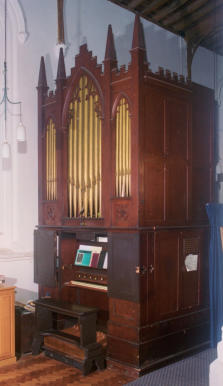
Originally a barrel organ, this instrument was purchased from St Peter & St Paul, Bassingbourn in 1865 for £100. In 1866 J.W. Walker
converted it into a barrel & finger organ.
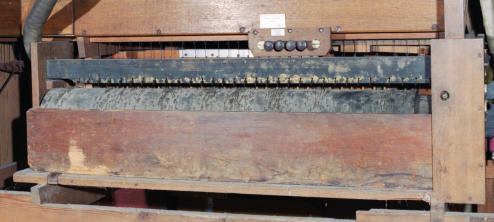
The barrel mechanism is operated from the rear. The Gothic case has three flats of gold painted dummy pipes (5-7-5).
Stop list at rear for barrel mechanism: Stopped Diapason 8’, Gamba Fifteenth 2’, Twelfth, Principal 4’.
Restored in 1974 by Norman Hall & Sons, Cambridge. Tunes recorded in 1998. BIOS Historic Organ Certificate awarded 2008 (certificate
of recognition).
Two (formerly three) green carriage-mounted barrels x 12 tunes. The original tunelist is illegible.
References: The Organist and Choirmaster (Jun. 1900) 52; ‘Notes of the Month’, The Antiquary (1907) 248; MacDermott (1948);
Boston & Langwill (1967); Turner (2002); NPOR, N03061.


BARREL 1
GREEN
Tune
Metre
BARREL 2
GREEN
Tune
Metre
2.1
[badly damaged]

© Maggie Kilbey & Marcel Glover 2026
Barrel Organs in English Parish Churches


Holy Trinity, Meldreth
(Cambridgeshire)
Originally a barrel organ, this
instrument was purchased from St
Peter & St Paul, Bassingbourn in
1865 for £100. In 1866 J.W. Walker
converted it into a barrel & finger
organ.
The barrel mechanism is operated
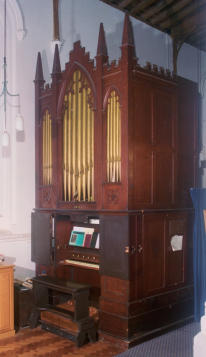
from the rear. The Gothic case has
three flats of gold painted dummy
pipes (5-7-5).
Stop list at rear for barrel
mechanism: Stopped Diapason 8’,
Gamba Fifteenth 2’, Twelfth,
Principal 4’.
Restored in 1974 by Norman Hall &
Sons, Cambridge. Tunes recorded in 1998. BIOS Historic Organ
Certificate awarded 2008 (certificate of recognition).
Two (formerly three) green carriage-mounted barrels x 12 tunes. The
original tunelist is illegible.
References: The Organist and Choirmaster (Jun. 1900) 52; ‘Notes of
the Month’, The Antiquary (1907) 248; MacDermott (1948); Boston &
Langwill (1967); Turner (2002); NPOR, N03061.

BARREL 1
GREEN
Tune
Metre
BARREL 2
GREEN
Tune
Metre
2.1
[badly damaged]