
© Maggie Kilbey & Marcel Glover 2026












St Mary, Stanstead St Margaret (Hertfordshire)

Barrel Organs in English Parish Churches
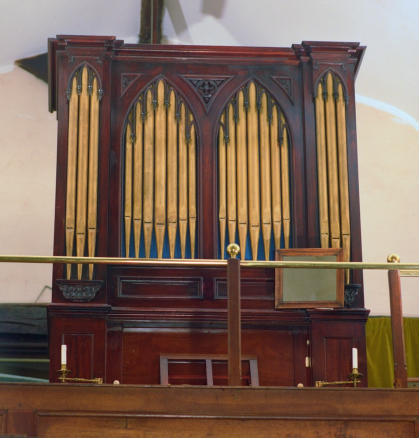
Barrel & finger organ, originally a chamber organ. A brass nameplate reads: ‘Guliemus Allen Fecit London’. In 1837 the chaplain Canon
Joseph Stephen Pratt restored the church and paid John Gray to convert the instrument to a barrel & finger organ.
The organ is located in the west gallery, which has folding seats. The barrel mechanism is operated from the rear, with the crank handle
on the right-hand side. The mahogany case has four flats of gold painted dummy pipes (3-7-7-3) backed with blue cloth. An electric
blower was installed in 1956.
Stop list: Open Diapason 8’, Stopped Diapason Treble 8’, Stopped Diapason Bass 8’, Dulciana 8’, Principal 4’, Fifteenth 2’.
Restored in 1989 by Saxon Aldred of Redbourn; barrels restored by Donald Simmonds in 1990-1. Tunes recorded in 1997. BIOS Historic
Organ Certificate awarded 2022 (Grade I).
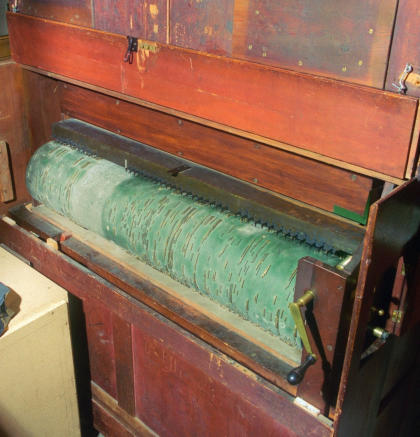
Four green carriage-mounted barrels x 8 tunes. There are no tunelists. The knife mechanism is not operational, so the keyframe has to
be lifted off the barrel manually.
References: Cadbury Research Library, Gray & Davison Ledger 1 (1837)
141; Boston & Langwill (1967);
Kilbey, Music-making in the Hertfordshire parish 1760 to 1870
(Hatfield, 2020) 168; NPOR, N14170.


BARREL 1
GREEN
Tune
Metre
1.1
[unplayable]
BARREL 3
GREEN
Tune
Metre
3.1
[unplayable]
BARREL 4
GREEN
Tune
Metre
4.1
[unplayable]

© Maggie Kilbey & Marcel Glover 2026
Barrel Organs in English Parish Churches


St Mary, Stanstead St Margaret
(Hertfordshire)
Barrel & finger organ,
originally a chamber
organ. A brass nameplate
reads: ‘Guliemus Allen
Fecit London’. In 1837 the
chaplain Canon Joseph
Stephen Pratt restored the
church and paid John Gray
to convert the instrument
to a barrel & finger organ.
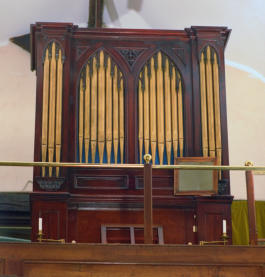
The organ is located in the west gallery, which has folding seats. The
barrel mechanism is operated from the rear, with the crank handle
on the right-hand side. The mahogany case has four flats of gold
painted dummy pipes (3-7-7-3) backed with blue cloth. An electric
blower was installed in 1956.
Stop list: Open Diapason 8’, Stopped Diapason Treble 8’, Stopped
Diapason Bass 8’, Dulciana 8’, Principal 4’, Fifteenth 2’.
Restored in 1989 by Saxon Aldred of Redbourn; barrels restored by
Donald Simmonds in 1990-1. Tunes recorded in 1997. BIOS Historic
Organ Certificate awarded 2022 (Grade I).
Four green carriage-mounted barrels x 8 tunes. There are no
tunelists. The knife mechanism is not operational, so the keyframe
has to be lifted off the barrel manually.
References: Cadbury Research Library, Gray & Davison Ledger 1
(1837) 141; Boston & Langwill (1967);
Kilbey, Music-making in the Hertfordshire parish 1760 to 1870
(Hatfield, 2020) 168; NPOR, N14170.

BARREL 1
GREEN
Tune
Metre
1.1
[unplayable]
BARREL 2
GREEN
Tune
Metre
2.1
[unplayable]
BARREL 3
GREEN
Tune
Metre
3.1
[unplayable]
BARREL 4
GREEN
Tune
Metre
4.1
[unplayable]